

How will the introduction of the Transparency Register for Interest Representation reshape the relationship between businesses and public institutions? Is Bulgaria ready for the new European anti-corruption requirements, and what do they mean in practice for public administration and the business community?
These questions were at the heart of the discussion held today, 27 November, by Transparency International Bulgaria with members of the Regional Public Council for Combating Corruption and Organised Crime at the Pernik Regional Administration.
The meeting focused on two forthcoming developments that directly affect both the public and private sectors: the new transparency rules governing interest representation and the transposition of the European Union’s Anti-Corruption Directive. In both cases, Bulgaria’s challenge is not merely to comply with legislative requirements but to translate them into effective mechanisms for more transparent governance and meaningful corruption prevention.
Mr Kalin Slavov, Executive Director of Transparency International Bulgaria, highlighted the forthcoming transposition of Directive (EU) 2026/1021 on combating corruption, which establishes a common European framework for preventing and combating corruption.
He emphasised that incorporating the new European requirements into national legislation should not be treated as another exercise in formal compliance with Bulgaria’s obligations, but rather as an opportunity to reassess existing policies and practices for identifying, assessing and managing corruption risks.
For public authorities, this means reviewing and updating anti-corruption policies, strengthening internal control mechanisms, enhancing transparency and accountability, and ensuring more effective coordination between institutions.
For businesses, the new European directive raises expectations regarding good corporate governance, the liability of legal entities and the effectiveness of internal corruption prevention mechanisms.
Particular attention was paid to the sanctions envisaged for legal entities, including potential restrictions on access to public procurement and public funding. In this context, corruption risk management is becoming increasingly important not only for regulatory compliance but also for companies’ competitiveness, financial resilience and reputation.
Ms Kremena Chobanova presented the new requirements for public authorities arising from the Act on Transparency in Interest Representation.
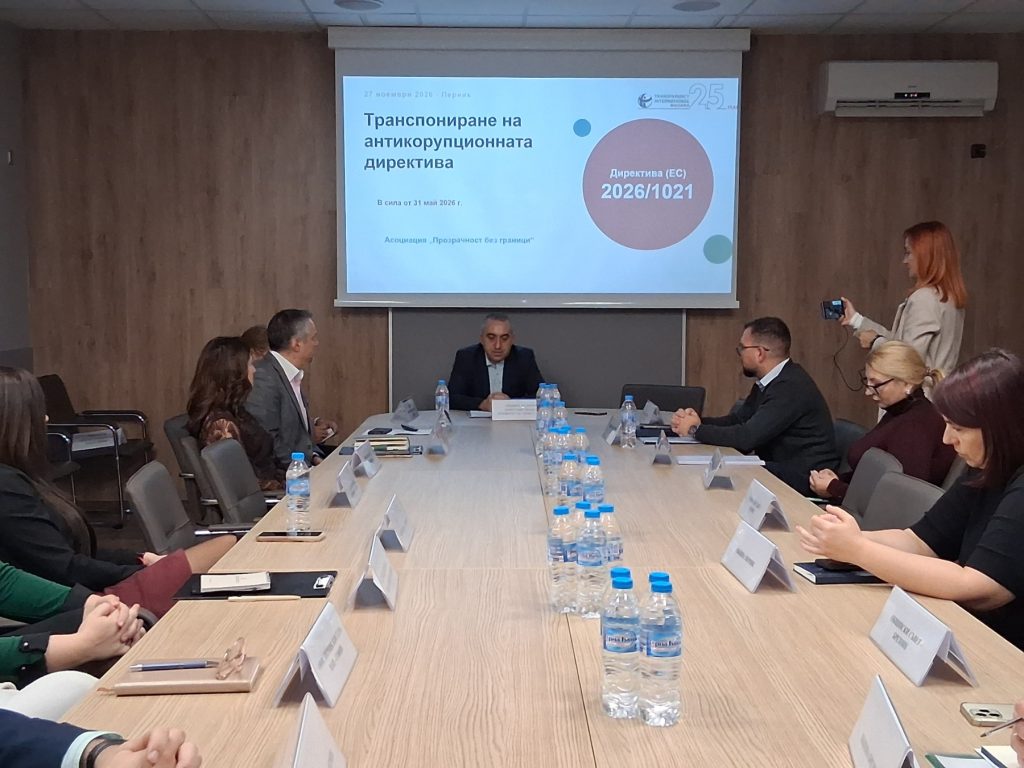
Discussing the new transparency rules governing interest representation and the forthcoming anti-corruption reforms with members of the Regional Public Council for Combating Corruption and Organised Crime in Pernik.
She focused on the practical operation of the Transparency Register, the specific obligations of public authorities in implementing the legislation, and the importance of the new regulatory framework in ensuring greater transparency in interactions between public institutions, businesses and civil society.
Over the past year, the National Council on Anti-Corruption Policies has not publicly reported on its activities, despite its mandate to coordinate institutional efforts to prevent and combat corruption.
The forthcoming transposition of the European directive requires a comprehensive analysis of existing legislation, a review of current corruption risk management mechanisms, and the preparation of concrete legislative and institutional reforms, with the active involvement of businesses and civil society.
The meeting held at the Pernik Regional Administration offers a positive example of how regional public councils for combating corruption can serve as effective platforms for cooperation between public administration and civil society.